Showing posts with label reviews: comics/graphics. Show all posts

Wednesday, November 18, 2020

Review: "Al Capp," Michael Schumacher & Denis Kitchen


By Paul Carrier

For more than four decades, beginning in 1934, Al Capp was one of the most successful comic-strip artists in America as the creator of Li’l Abner; at its peak, the cartoon ran in close to 1,000 newspapers. Yet Capp, his talent and popularity notwithstanding, was a troubled man.

Irascible, judgmental and sometimes mean-spirited, he was a highly visible and vocal satirist who cheated on his wife, was accused of sexually assaulting young women and grew intolerant of leftist politics once he abandoned his own liberal views.

Published in 2013, Al Capp: A Life to the Contrary is the first major biography of the legendary cartoonist who transported generations of eager readers to Li'l Abner's hometown of Dogpatch, a fictional backwater somewhere in the hillbilly country of rural Kentucky.

Wednesday, February 28, 2018

Review: "Cartoon County," Cullen Murphy


By Paul Carrier

It’s a safe bet that most fans of newspaper comics don’t give them too much thought. They may read Pearls Before Swine with their morning coffee, or scan the latest episode of Pickles before turning to the sports page and then heading out to work.

Some readers are more obsessive about their cartoons, collecting reprints in book form and devouring the occasional biographies that chronicle the lives of, say, Charles M. Schulz (Peanuts), or George Herriman (Krazy Kat) or Al Capp (Li’l Abner).

But for those with the most insatiable appetites, there’s no substitute for an account written by someone who was present at the creation, so to speak.

That’s what Cullen Murphy provides in Cartoon County, a firsthand look at the quirks and the art of prominent American cartoonists and illustrators who lived in or near Fairfield County, Conn., during the mid 20th century. These highly talented and idiosyncratic artists came to be known as the Connecticut School, practicing their craft during an era that Cartoon County’s subtitle describes as “the golden age of make-believe.”

This close-knit but informal club was a who’s who of cartoonists and illustrators from that period: Chuck Saxon, whose cartoons and covers graced The New Yorker for years; Mort Walker (Beetle Bailey); Bud Sagendorf (Popeye); Leonard Starr (Little Orphan Annie); Stan Drake (Blondie); Dik Brown (Hägar the Horrible); and Ernie Bushmiller (Nancy); among many others.

Although Cartoon County ranges afield, offering telling glimpses into the personalities and habits of several cartoonists, its primary focus is on Cullen Murphy’s father. John Cullen “Jack” Murphy illustrated the boxing comic strip Big Ben Bolt during its entire run, from 1950 to 1978. But the senior Murphy probably is best known for his 30-plus years of work on Prince Valiant. He began as an assistant to the Sunday strip’s creator, Hal Foster, in 1970, before assuming the mantle later on.

Born in 1952, Cullen Murphy was old enough to observe his father at work on both strips. Moreover, the younger Murphy took over the writing of Prince Valiant after Foster, who both drew and wrote the strip, called it quits in 1979. Foster's retirement transformed the Murphys into a creative father-and-son team. Jack illustrated; Cullen scripted.

The world described in Cartoon County is no more, thanks in part to the declining fortunes of the newspaper industry and the growth of the Internet as a mechanism for distributing just about anything, including cartoons.

Things were far different when Cullen Murphy was a boy.

“For cartoonists in America, the 1950s were the Cretaceous revolution. Conditions on planet Earth had never been so propitious,” Murphy writes. Back then, the country supported some 300 morning newspapers, 1,500 afternoon papers and 500 that were published on Sundays. “Those Sunday newspapers, with their thick comics sections, had a combined circulation of fifty million,” which exceeded the number of households in America. The Sunday funnies were so popular that, often, the comics section was wrapped around the rest of the newspaper, to assure that a paper’s biggest draw -- the funnies -- were front and center on the newsstand.

Murphy’s recollections are hard to pigeonhole, combining as they do elements of biography, memoir and comics history in a richly illustrated homage to a time and a place that obviously conjure up fond memories for him.

The illustrations alone — there’s at least one on almost every page — justify the price of admission. But Cartoon County has much more going for it than reproductions of photos, cartoons and other artwork. Murphy is a talented and experienced wordsmith who has produced a charming tribute to Jack Murphy and his friends. In addition to writing Prince Valiant for a time, the Amherst College grad is the author of several books, editor at large at Vanity Fair, and former managing editor of The Atlantic.

Armed with a wealth of historical information, a son's devotion to his father, keen insights into the world of comics and delightful anecdotes about some of cartooning's legends, Murphy lovingly resurrects the “vaguely anarchic” world of these Connecticut-based cartoonists who filled in at the drawing board when a pal was laid up by injury or illness and constantly grappled with their own tight deadlines, all within the quasi-puritanical mores of their era. In those long-gone days, for example, women in comic strips could be depicted in bikinis, but there was no tolerance for male nipples, which, Murphy writes, “presented a challenge for strips about prizefighters, cavemen, or barbarians.”

Saturday, April 22, 2017

Review: "Schulz and Peanuts," David Michaelis


By Paul Carrier

It’s no exaggeration to say that several generations of people grew up with Peanuts, the comic strip Charles Schulz launched in 1950 and continued until the day before his death in 2000. Over the years, Peanuts made the transition to big and small screens, the stage, product endorsements, and countless forms of merchandising, including plush Snoopy dolls. The strip itself is still around, in reruns and anthologies.

Charlie Brown, Lucy, Linus, Woodstock and the rest of the gang remain beloved characters, easily recognizable icons of American pop culture. But what of Charles Monroe Schulz, the genius who created them all and released them into the world?

Peanuts fans may believe they know little about the legendary cartoonist. But as David Michaelis makes clear in Schulz and Peanuts, an exhaustive and provocative biography, readers familiar with Schulz’s work do, in fact, have more than a passing familiarity with the man himself, because the strip was so heavily autobiographical.

Peanuts did not literally track Schulz’s life, but his temperament, values and outlook permeate the comic. Read the strip closely enough and you’ll come away with a pretty good sense of what made Schulz tick, and how his life changed over the years.

Michaelis, who also has written a biography of famed illustrator N. C. Wyeth, makes it clear throughout Schulz and Peanuts that Sparky, as Schulz was known, mined his own quirks, as well as his life’s successes, failures, joys and frustrations, to breathe life into his creations.

Time and time again, Michaelis details some important development in Schulz’s life, or an aspect of his personality, that the book illustrates with a remarkably pertinent Peanuts strip, dozens of which are scattered throughout the text for just that purpose.

Charlie Brown may not be Charles Schulz’s doppelganger, but they do bear a striking resemblance. As a boy, the shy, introverted and highly sensitive Schulz felt misunderstood. He nursed grievances, found it difficult to talk to pretty girls and had what Michaelis calls a “lifelong sense of aloneness and incompleteness.” Schulz and his first wife, Joyce, were often likened to Charlie Brown and Lucy van Pelt. Even as a husband (during his first marriage) and father, Schulz felt unloved. He appears to have been melancholy throughout his life.

In other words, Schulz’s travails were a lot like those of a certain big-headed, round-faced kid with a zigzag on his shirt. And the taken-from-life roots of the comic strip did not end there. Schulz claimed to have given his wishy-washy ways to Charlie Brown, his sarcasm to Lucy, his dignity to Linus, his perfectionism to Schroeder, and his sense of being unappreciated to Snoopy.

Shermy, an early Peanuts character, is named after Schulz’s childhood friend, Sherman Plepler. Snoopy was inspired by the young Schulz’s pet pooch, Spike. The tiny bird Woodstock resents being called Shorty, a demeaning moniker that some kid gave Schulz when he was a sophomore in high school. As for the famed Little Red-Haired Girl, she had a real-life counterpart as well.

Still, the comparisons only go so far. Michaelis leaves no doubt that Schulz was a far more complex, even contradictory, man than his avuncular public image suggested. He suffered from panic attacks as an adult, for example, and reached a point where he was reluctant to take trips that kept him away from home overnight. As a result, he sometimes canceled scheduled appearances at the last minute if they would have required traveling long distances.

Highly intelligent and well-read, Schulz liked to portray himself as simple and ordinary. Raised in a secular home, he became an evangelical Christian as a young man, but later embraced a more liberal, humanistic faith. Deeply protective of the Peanuts characters, he nonetheless allowed them to be used in commercial ventures, from Ford ads to nicely packaged collections of aphorisms that arguably presented the strip's cast members as much more saccharine than they were in their original newspaper format. Made famous and wealthy by a strip starring children, Schulz was not especially fond of kids (other than his own) and could be misanthropic.

Schulz and Peanuts will appeal to devoted fans of the classic strip and, more generally, to students of the genre’s history. But in a larger sense, this psychologically probing biography is an insightful look at a man who knew what he wanted from childhood, persevered until he succeeded, and then stuck with it for half a century. Eventually, Peanuts ran in 2,600 newspapers in 21 languages, attracting 300 million readers from 75 countries.

It was Schulz’s uncle who nicknamed his newborn nephew Spark Plug (later shortened to Sparky) back in 1922, after a horse in the Barney Google comic strip. So perhaps it could be argued that Schulz was destined for a life in “the funny papers” from the get-go. Yet as deserving as Schulz is of a close look at his life and psyche, the art was more compelling than the artist. At 566 pages, Schulz and Peanuts could have used tighter editing, to trim it to a more manageable length.

Tuesday, January 10, 2017

Review: "Krazy," Michael Tisserand


By Paul Carrier

Poet E. E. Cummings was a big fan. So were T. S. Eliot, Langston Hughes, Carl Sandburg and Woodrow Wilson. In 1924, writer Gilbert Seldes called it "the most amusing and fantastic and satisfactory work of art produced in America today.” Vanity Fair compared the humor and originality of this “nonsense creation” to that of Alice's Adventures in Wonderland. Cartoonists from Charles M. Schulz to Bill Watterson have described it as a major influence on their work. Some experts contend it was the greatest comic strip of all time.

George Herriman’s verbally dazzling and visually intoxicating Krazy Kat, which ran from 1913 until its creator’s death in 1944, remains very popular with scholars and comics aficionados. Reprints of the strip have been available in book form for years. But Herriman himself has received nowhere near as much attention as has his greatest achievement.

Michael Tisserand sets out to fill that void in Krazy: George Herriman, a Life in Black and White, an exhaustive and enlightening biography that runs to more than 400 pages, plus notes and an 18-page bibliography. It is the first full-scale biography of a man hailed by some as a genius.

This is a must read for all Krazy Kat fans, not only because of Tisserand’s thoughtful examination of Herriman’s work but also because the author sheds so much light on the elusive artist, a humble, modest man of mixed race.


In fact, the subtitle of Tisserand’s book is as much a comment on Herriman’s ancestry as an acknowledgement that much of his work appeared in black and white. Herriman seemed to go out of his way to hide his roots, which is understandable considering the times in which he lived. While some of Herriman’s early cartoons played up cruel racial stereotypes, which were a staple of many early comics, he used Krazy Kat as a vehicle to attack racism, and to poke fun at its absurdity.

Born in 1880 in New Orleans to French-speaking Creoles, Herriman spent his early childhood there before his family moved to California. “When I learned more about his family, I understood a bit more not just the pressures he must have felt in passing for white, but also the strange, unsettling feeling it must have been to identify with a group of people historically known as Free People of Color, or Mulatto, or Creoles,” Tisserand said in a 2016 interview with The Comics Journal. Herriman hailed from a group “that constantly was seeing its very identity being changed legally and linguistically and culturally.”

Tisserand chronicles the tortuous path of Herriman’s development as a cartoonist, as he bounced between Los Angeles and New York cranking out political and sports cartoons, as well as a long list of short-lived comic strips before (and in some cases after) Krazy Kat saw the light of day. Herriman moved from one employer to the next, and from strip to strip, until he and his Kat finally settled into William Randolph Hearst’s publishing empire.

Tisserand is so meticulous that it’s more than 200 pages into the biography before Herriman finally gives birth, as it were, to Krazy, although the Kat does turn up earlier in some of the many illustrations that Tisserand uses to showcase Herriman’s work. 

The basic premise of the strip was straightforward slapstick, starring anthropomorphic animals (there are no humans in Krazy Kat) whose physical humor and eccentric language shared star billing with a kaleidoscope of bold, ever-shifting settings based on Herriman's beloved Southwest.

Krazy, a black cat whose gender shifts back and forth, loves a white mouse named Ignatz, who routinely beans Krazy with a brick. Krazy interprets these assaults as expressions of affection, which further angers Ignatz. Offissa Bull Pupp, the third major character in a strip replete with other animals, loves Krazy and tries to shield him/her from Ignatz. So, a cartoon cat with no fixed gender is routinely attacked by a mouse and protected by a dog. It doesn’t get more original than that.

But that isn’t the half of it. Krazy Kat was anything but simple or formulaic. Herriman broke the mold in many ways, leaving some newspaper readers unimpressed with his  unique wordplay, whimsical spelling, and artistic originality. The intelligentsia may have loved Krazy, but the general public’s reaction was decidedly mixed.

Herriman “layered Krazy Kat in visually and verbally dense allegories of fate and free will, good and evil, and reality and illusion,” Tisserand writes. As far back as the 1920s, fans saw the strip as “an emblem of a modern age” because it was “in a state of constant reinvention.” Still, Herriman’s “philosophical musings, literary allusions, restless desert scenery, and enigmatic lead character made for a challenging read.”

Although he was not fully appreciated in his lifetime, hindsight shows that Herriman was an artistic giant. His work has come into its own and now, at long last, Herriman does so as well in this thoughtful, thoroughly researched and well-illustrated biography.


Monday, April 13, 2015

Review: "Exploring Calvin and Hobbes," Bill Watterson

Comics review of Exploring Calvin and Hobbes by Bill Watterson

By Paul Carrier

It only had a 10-year run, but Calvin and Hobbes, which follows the adventures of an untamed six-year-old boy and his (supposedly) stuffed tiger, is universally recognized as one of the greatest comic strips of all time.

There are many collections of the strip in print, most notably The Complete Calvin and Hobbes, a multi-volume set that includes all of Bill Watterson’s strips. Now comes Exploring Calvin and Hobbes, the catalogue for an exhibition at the Billy Ireland Cartoon Library & Museum in Ohio. Which raises an obvious question: What could yet another book possibly add to the wealth of material that’s already out there?

The answer is Watterson himself. The reclusive cartoonist has granted few interviews since he decided to discontinue the strip 20 years ago. This catalog’s 35-page exchange between Watterson and Jenny E. Robb of Ohio State University, where the Billy Ireland Cartoon Library & Museum is located, sets the slim volume (152 pages) apart. You won’t find tons of strips here, but you will gain new insight into Watterson and his comics masterpiece.

The cartoonist has a strong connection to the Billy Ireland Cartoon Library & Museum, which has housed more than 3,000 original Calvin and Hobbes comic strips and related materials since Watterson placed the collection there back in 2005.

Thanks to those ties, it’s not especially surprising that Watterson, an Ohio native, agreed to be interviewed for this catalogue. But what he has to say here is revealing, and it makes for rewarding reading, especially because Watterson has been so reticent about himself and his craft over the years.

Watterson is thoughtful and articulate as he discusses his childhood, his early years as a cartoonist, the development and success of Calvin and Hobbes, his thoughts on what the future holds for comic strips, and his reputation as a hermit of sorts.

Watterson notes, for example, that, as a boy, his family home in Chagrin Falls had “a big woods” behind it, and he “loved having that much nature around us . . . . Having something a bit wild and mysterious and beautiful at the end of the yard was a memorable thing.” Calvin and Hobbes fans well know that many of the more memorable strips place the duo out in the woods.

As he struggled to make a living as a cartoonist in the early going, Watterson explains that he submitted many unsuccessful ideas to syndicates. But even as he thrashed about looking for a winner, “I never tried submitting a kid strip” until an editor suggested that he do just that.

Enter Calvin. And Hobbes.

As for his decision to call it quits after only a decade, Watterson said he had several reasons for doing so, including the fact that he worked so hard writing and drawing Calvin and Hobbes that “I eliminated pretty much everything from my life that wasn’t the strip.” By the end, Watterson said, “The strip was as close to my vision for it as I was capable of doing. I was happy with what I had achieved, and the strip’s world seemed complete.”

The strips that are reprinted here are organized thematically, and they are accompanied by other chapters that provide helpful context. These ancillary chapters focus on such topics as cartoonists who influenced Watterson, examples of his early work, Watterson’s eventually successful efforts to get syndicated, and a somewhat humorous look at the tools of his trade.

The catalogue uses examples of the strip to examine the relatively small cast of characters in Calvin and Hobbes, the importance that the changing seasons play in the strip, the recurring devices Watterson used (such as Hobbes’ penchant for attacking Calvin whenever he returns home), and the evolution of Watterson’s Sunday strips.

Robb writes in the preface to this indispensable addition to any Calvin and Hobbes collection that Watterson’s now-legendary strip had it all, including, “humor, heart, and wisdom wrapped up in a beautiful package of sophisticated and lively graphic storytelling.” Exploring Calvin and Hobbes opens a new window on that world.

Thursday, August 21, 2014

Review: "Walt Before Skeezix," Frank King

Comics review of Walt Before Skeezix, by Frank King

By Paul Carrier

Every fan of early comic strips is familiar with Gasoline Alley, which Frank King created in 1918. King is long gone, but his pen has been passed on to various successors since he relinquished the Sunday strip in 1951 and the daily in 1959. Gasoline Alley continues to this day, making it the second-longest-running comic strip in the country.

At the outset, Gasoline Alley was true to its name. It starred four friends — Walt, Bill, Avery and Doc — who spent an inordinate amount of time hanging out in a back alley talking cars and tinkering. Their wives (Walt was the lone bachelor) made appearances as well, often grumbling about the amount of time their husbands devoted to their jalopies.

Then in February 1921, Gasoline Alley took a dramatic turn. That’s when someone left a newborn boy on Walt doorstep. He adopted the infant (named Skeezix) and raised him on his own until he married Phyllis Blossom in 1926. Walt’s clan grew from generation to generation, thanks to King’s radical notion that comic-strip characters should age in real time.

Jim Scancarelli, who has drawn the strip since 1986, killed off Phyllis in 2004, but Walt (now well over 100 years old) and Skeezix live on. The strip has a devoted following among aficionados, and is widely viewed as one of the greatest comic strips of all time. To satisfy that addiction, Drawn and Quarterly, a Montreal company, has been publishing an ongoing series of handsome hardcover reprints which, so far, cover strips from 1921 through 1930.

That Walt and Skeezix set, the sixth volume of which is due next year for 1931 and 1932, began with the strips immediately preceding Skeezix’s birth in 1921. But wait a minute. King launched Gasoline Alley in 1918. So, what has become of those pre-Skeezix strips, which focused on the camaraderie of Walt and his pals more than the domestic motif of the later years?

Once again, Drawn and Quarterly has come to the rescue, this time with the aptly titled Walt Before Skeezix, which was released this year. In addition to reproducing comics that ran from Nov. 24, 1918 through Dec. 31, 1920 — both single panels and, later, sequential strips — Walt Before Skeezix
features a thoughtful introduction by  Canadian journalist and comics scholar Jeet Heer. The subject of the early strips is “male fellowship,” Heer notes, “the way a shared interest in cars becomes an occasion for affectionate and mutual mockery.”

Artist and cartoonist Chris Ware penned the preface to this handsome, thick and hefty volume, which is similar in size and format to the Walt and Skeezix series. Period photographs, sketches and other ancillary items provide context, as do helpful endnotes by Tim Samuelson explaining many of the topical references in the cartoons. Walt Before Skeezix even includes King’s diary entries from 1915 and 1916.

As Heer points out, the first Gasoline Alley strips are filled with “false starts, failed experiments and erratic gropings.” But King found his legs over time. By 1920, his style had matured, with a cleaner, crisper line and a smaller, more stable cast of characters.

Human nature doesn’t really change very much over time — certainly not in the last 100 years or so — and the antics and attitudes that fill these early strips will not be foreign to 21st-century readers. The guys in the alley always are on the lookout for dubious ways to cut costs by investing in untested gimmicks, such as the “jigger” Avery buys for his car because it supposedly will “save 20 percent on gas.”

There are other recurring themes as well, including Walt’s insistence that he’s better off as a bachelor because his married pals are henpecked, Avery’s obsessive penny-pinching and the gang’s repeated attempts to get Doc to prescribe medicinal alcohol once Prohibition takes effect.

But if the stories King tells are recognizable, the lingo of the era is pleasingly exotic to our ear. These alley cats prattle on about such things as a bus (car); a bird (man); drag (political influence); and coin, beans and simoleons (money). A license plate is a number, a cheap car is a flivver, a friend is an old top and a car’s acceleration speed is its getaway.

Like the Gasoline Alley of the ensuing decades, the earliest strips in Walt Before Skeezix find gentle humor in middle-class normalcy and the quotidian details of 20th-century life. It’s a bygone era worth visiting, if you have Frank King as a guide.


Tuesday, July 6, 2010

Review: "The Definitive Prince Valiant Companion," Brian Kane


By Paul Carrier

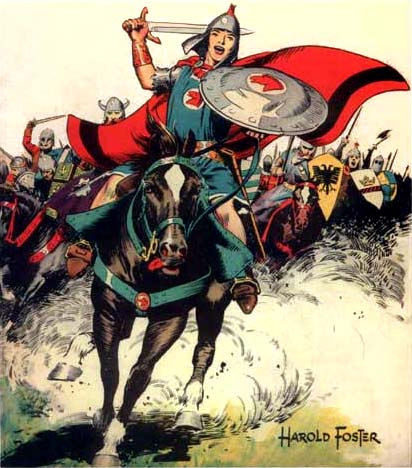
Created in 1937 by illustrator and cartooning legend Hal Foster, Prince Valiant takes us to King Arthur’s court, where Val, the young son of an exiled Nordic king, advances from squire to knight of the round table and sets off on a seemingly endless series of fanciful adventures that take him around the world. 

Foster is long gone (he died in 1982) but various artists and writers have assumed his mantle over the years, and his much-admired epic remains in circulation to this day. Known for its detailed artwork, stunning realism, literacy, sometimes humorous domestic story lines and high drama, Prince Valiant certainly deserves a reference book of its own. Now it has one. 

Edward, Duke of Windsor, once described Prince Valiant as the “greatest contribution to English literature in the past hundred years,” which is, of course, a ridiculous overstatement. Still, it underscores the exalted spot that Prince Valiant holds in the annals of comic-strip history. 

As King Features Syndicate, which distributes the strip, explains on its web site, Prince Valiant is “a historical novel in serialized form, one in which characters have more than two dimensions — the virtuous have flaws, and the villainous are frequently not without some small virtue. The characters have known defeat as well as triumph. And they have aged over the years.” 

First published in 1992 and reissued in updated form in 2009, The Definitive Prince Valiant Companion fills a void for the student of all things Val. In addition to full-color pages from various period’s in the strip’s history and black-and-white illustrations, the book offers an invaluable story synopsis that runs from 1937 through August of last year. 

Also included is a timeline of Val’s life, summarizing the highlights from his birth circa 433 through the next 40-plus years. Well-focused interviews with Foster successors John Cullen Murphy and the artist/writing team of Gary Gianni and Mark Schultz are part of the mix as well. But there are sins of omission and commission here too. 

Noticeably lacking are brief biographical sketches of the major characters in the strip, which would have been beneficial because Prince Valiant has covered a lot of ground in its 73 years of weekly strips. (There never was a daily strip.) We could use a bit of help sorting out King Arthur, Sir Gawain, Sir Tristram, Merlin, Mordred, Val’s wife Aleta, their children, and the countless villains and heroes who have filled the strip’s pages, either on a recurring basis or in passing. 

The Definitive Prince Valiant Companion also features a fawning, overly long, interview with Foster that was conducted late in his life. This exchange includes some revelations, such as the fact that Foster thought cartooning was beneath him when he began illustrating Tarzan several years before the creation of Prince Valiant. But the interview would have benefited from some judicious editing. 

This handsome volume’s assets outweigh its deficiencies, however, and it is a must for any library devoted to classic comic strips.

Friday, June 11, 2010

Review: "Big Nate," Lincoln Peirce


By Paul Carrier

Suppose you were named Nate. (No, not Nate Robinson of Boston Celtics fame, but God bless him!) And suppose you were a smart, rambunctious, spiky-haired, Cheez-Doodle-crazed sixth grader with delusions of grandeur who's always getting in trouble at school because the dorky teachers obviously are out to get you.

And suppose you were a chess-playing, dog-loving, cat-hating, budding cartoonist with a super crush on a girl who can't stand your guts. And suppose there was an actual, real-world comic strip named after you, to chronicle your adventures. What would it be called?

How about Big Nate, by Lincoln Peirce? (No, that’s not a typo. It really is spelled “Peirce.”)

Launched in 1991, Big Nate appears in more than 200 newspapers. We’re especially fond of it here in Maine because Peirce attended Colby College in Waterville and now lives in Portland.

Peirce’s new book, Big Nate: In a Class by Himself, is not a collection of previously published strips. Instead, it features a new, book-length story narrated by Nate and heavily illustrated with comics about or by . . . Nate! Anyone familiar with the strip will recognize the cast of characters and the goings on at Nate’s school, but Big Nate: In a Class by Himself serves as an introduction to the strip for newcomers as well.

After giving readers a primer on his family and his school, Nate heads off to P.S. 38, where a friend gives him a fortune cookie whose fortune reads: “Today you will surpass all others.” Nate spends the rest of the day (and the rest of the book) trying to figure out how to make that fortune come true, and finally succeeds in spectacular fashion. (Well, sort of.)

Let’s be clear: this is a kid’s book, as Peirce is the first to admit. But if you like the strip already, or even if you simply recall life as a kid, you’ll enjoy the book, no matter how old you are.

In a recent interview with the Maine Sunday Telegram, Peirce explained that he wrote (and illustrated) the book “to find a way to tell a longer story.” While the newspaper strip is aimed at all age groups, Peirce noted that Big Nate: In a Class by Himself “is very specifically targeted for younger readers" in the 8-to-12 set.

Peirce said one of his goals was to write a book "that I would have loved to read when I was a kid. Kids are so visual. That is how I looked at books as a kid when I went to the library. I'd flip through the book to check out the pictures. This is a book for kids who like comics and who like a good story.”

Kids of all ages, that is. I mean, this book even includes a haiku that Nate wrote for class in honor of his favorite snack, the gloriously golden Cheez Doodle: 

You have Cheez Doodles.
Fresh. Crunchy. Puffalicious.
Give me one right now. 

What’s not to love?

Monday, February 15, 2010

Review: "The Book of Genesis Illustrated," R. Crumb


By Paul Carrier

Of all the contemporary artists who might take on the daunting task of illustrating the entire Book of Genesis, could any seem more unlikely than Robert Crumb?

A leader of the underground comix movement in the 1960s and 1970s, Crumb is the creator of such countercultural icons as Fritz the Cat, Devil Girl, Mr. Natural and innumerable, shall we say, libidinous women.

Admired by countless fans as a gifted artist with a unique, instantly recognizable, style, Crumb is controversial as well, and has been accused of sexism and racism over the years. Let's just say that, as a rule, his work is not likely to be found in very many school libraries. Nor should it.

Yet Crumb has now produced The Book of Genesis Illustrated, a monumental undertaking that took him several years to complete. It covers all 50 chapters and literally everything to be found in them - the creation, Adam and Eve, Cain and Abel, the numbingly endless “begats,” Noah and the flood, the Tower of Babel, the fall and rise of Joseph. You name it. It's all here.

Being Crumb, the artist doesn’t shy away from the naughty bits. That’s why the book comes with two warnings on the cover, one recommending “adult supervision” for minors and the other reminding readers that there is “nothing left out.”

This may be a comic book of sorts, but it’s no sanitized abridgement.

“I didn’t want to edit it at all. I wanted every word in there,” Crumb said in an interview with National Public Radio last year. “That was part of the discipline of it was to keep every word, because if you start leaving stuff out, then you’re playing God.”

Crumb, skilled artist that he is, certainly is up to the task of illustrating most anything, including the Book of Genesis. What gave me pause when I started reading the book was not whether he did the job well - he did - but whether readers familiar with his more salacious work will readily accept this transition from the profane to the holy.

For his part, Crumb does not view Genesis as the word of God, but rather as a fascinating collection of wonderful stories - "the words of men," as he puts it in the introduction - that deserve to be told in comic-book form.

“I decided just to do a straight illustration job,” Crumb said in the 2009 NPR interview, “because the stories themselves are so strange that it doesn’t need satirizing. It doesn’t need, you know, making fun of or taking off on or anything. It just stands up on its own as a lurid, you know, comic book.”

For example, God, as drawn by Crumb, looks just like what you would expect - robed, patriarchal, angry, with flowing white hair and a long white beard. In fact, everyone in the book looks suitably "biblical." True to his word, Crumb takes no liberties, cracks no jokes and shows no disrespect.

What I found is that The Book of Genesis Illustrated, while surreal in the early going because I was preoccupied with the juxtaposition of Crumb’s notoriety and Genesis, grew on me in the chapters that followed.

By the time Abraham comes along, for example, I was so caught up in the story, and sufficiently impressed with Crumb’s skill, that his background as a self-described pornographer receded from my thoughts.

By then, the experience of reading Crumb’s take on Genesis was no longer awkward, but entirely enjoyable. Whether you view Genesis as divinely or humanly inspired, Crumb brings it to glorious life in The Book of Genesis Illustrated.


Monday, October 19, 2009

Review: "Walt and Skeezix, Book Three," Frank King


By Paul Carrier

This third volume in an ongoing reissue of the late Frank King's Gasoline Alley comic strip is, like both of its predecessors, an absolute joy. "Uncle Walt" Wallet and his adopted son, Skeezix, continue their adventures in "the alley," along with Walt's car-loving pals Doc, Bill, Avery and the rest of the gang. 

A classic American comic strip that is justly viewed as one of the greatest strips of all time, Gasoline Alley has been in continuous publication for some 90 years or so, under various artists, and is cherished by devoted fans and comics scholars alike. With this series, it has become much easier for fans of the earlier - some would say more glorious - strips to get their fix. 

In Walt and Skeezix: Book Three, which covers daily strips from 1925 and 1926, the long courtship between Walt, who began the strip as a confirmed bachelor, and Phyllis Blossom finally reaches its inevitable conclusion as the two lovebirds head to the altar. 

And in keeping with Gasoline Alley's claim to fame as a strip whose characters age in real time, the irrepressible Skeezix, whom Walt adopted when he found the infant tucked into a basket on his doorstep, progresses from the broken English of a prechooler to the more mature speech of a slightly older boy. 

Walt and Skeezix: Book Three presents the two-year run of strips in context, with photos of King and his family, an introductory essay by Canadian journalist Jeet Heer, reproductions of early merchandising efforts and an appendix of explanatory notes. 

This old gem of a strip, with its gentle humor and meandering ways, is an acquired taste that many newcomers may find hard to take in our fast-paced, techno-crazed 21st century. 

But those seeking a heartwarming escape into a world that is full of whimsy and the constant devotion of loving families and close friends will be rewarded by taking a spin through Gasoline Alley in this lovingly conceived volume. 

The handsome hardcover books in this series, published by Drawn & Quarterly Books of Montreal, are a must-have for diehards and a must-try for the uninitiated. 

Here's hoping this run of reissues continues for a long time to come. (There certainly is plenty of material!) As things stand now, a fourth volume covering daily strips from 1927 and 1928 is scheduled to be released in June 2010.