Showing posts with label reviews: Vowell (Sarah). Show all posts

Thursday, December 17, 2015

Review: "Lafayette in the Somewhat United States," Sarah Vowell

History review of Lafayette in the Somewhat United States by Sarah Vowell

By Paul Carrier

How best to describe Sarah Vowell, whose latest book, Lafayette in the Somewhat United States, hit the shelves this year?

Vowell is the author of several books dealing with history, although she probably would be the first to admit that she’s no historian, at least not in the traditional sense of that word. She blends travel, humor, journalism and analysis, marrying history, pop culture and personal anecdotes to bring the past to life in a manner that can be laugh-out-loud funny one minute and deeply moving the next.

Lafayette in the Somewhat United States covers a lot of ground, examining the marquis’ youth and upbringing in France, his arrival in America, his role as a general in the Continental Army, and his unflagging devotion to George Washington. But this slim volume also provides context, by pulling back from Lafayette to explore the revolution as a whole. It's a meandering review, yet one that always works its way back to the roles played by Lafayette and the nation of his birth.

“I write books for the general reader; I’m not some kind of scholar,” Vowell said in an interview posted on americanlibrariesmagazine.org. “Knowing that for some of my readers this is going to be the only book they read on the revolution, I think it kind of broadened the scope of the book a little bit.”

That scope is broad indeed. One of Vowell’s trademarks is her fondness for digression, and that’s on display here.

For example, Vowell’s recap of the Battle of Monmouth (in New Jersey) works in asides on Bruce Springsteen and the George Washington Bridge lane-closure scandal (aka Bridgegate) that has undermined the credibility of N.J. Gov. Chris Christie. So if you find linking the seemingly unlinkable off-putting, Vowell may not be for you.

A central theme of the book is Vowell’s claim that Americans always have been, as we certainly are now, naturally contentious. Yet Lafayette was, in his lifetime, a genuine and universally admired American hero. Vowell recounts the wildly enthusiastic reception Lafayette received during a triumphal return visit to the United States in 1824-25, by which time he was the last surviving general of the Continental Army and a living symbol of the alliance with France that secured American independence.

Vowell explains that Lafayette’s appeal stems in large part from the fact that he was something rare in our history and politics: a unifying force. “Other than a bipartisan consensus on barbecue and Meryl Streep, plus that time in 1942 when everyone from Bing Crosby to Oregonian schoolchildren heeded FDR’s call to scrounge up rubber for the war effort, disunity is the through line in the national plot,” Vowell writes, “not necessarily as a failing, but as a free people’s privilege.”

France’s role in securing America’s freedom gets special attention from an admiring Vowell, who explains that Louis XVI sent a mountain of supplies to the patriots even before France formally recognized the rebels and entered the war. Especially memorable is Vowell’s retelling of the Battle of Yorktown, where French forces actually outnumbered the Americans. If there is a great unsung hero of the revolution, a forgotten player whose decisions at Yorktown effectively gave the United States its independence, it is François Joseph Paul de Grasse, the French admiral whose massive and powerful fleet bottled up the British army at Yorktown.

Americans celebrate Independence Day rather than Yorktown Day, Vowell writes, because even though we broke with Great Britain on our own initiative, it was France that won our revolution for us. “Who wants to barbecue a hot dog and ponder how we owe our independence to the French navy?” Vowell writes. 

Vowell’s always-entertaining irreverence, which has long been one of the highlights of her take on history, shines through in her latest book. Witness her assessment of the decision by the Continental Congress to commission the inexperienced 19-year-old Lafayette as a major general after he offered to serve in the Continental Army without salary.

The Continental Congress “had its doubts about saddling General George Washington with a teenage French aristocrat,” Vowell writes, “but Ben Franklin wrote from Paris that the kid might be of use and, what the hell, the price was right.”

Monday, September 26, 2011

Review: "Assassination Vacation," Sarah Vowell


By Paul Carrier

If you conjured up a mildly neurotic writer whose persona includes equal parts insightful humorist, irreverent history buff, keen trivia fan, wry observer of the passing scene, and devotee of the offbeat, with just a pinch of self-absorption thrown in for good measure, you’d have a close approximation of Sarah Vowell. 

And if you gave that writer enough of an interest in the untimely deaths of U.S. presidents to send her scurrying around the country peering at monuments, memorials, museums and mementos, including the occasional body part, you’d have Assassination Vacation, Vowell’s quirky look at the killings of Abraham Lincoln, James Garfield and William McKinley. 

This 255-page mashup of blasts from the past, travelogue and personal essay makes for a quick read that is at once educational and damn funny. Visiting the Confederate White House in Richmond, Va., with a friend, for example, Vowell suddenly realizes that her male pal, who is peppering a matronly staffer with questions, is wearing a T-shirt emblazoned with the words: "Porn Freak Rehab."

We learn that bed-and-breakfasts make Vowell nervous. (She’s expected to chat with strangers while eating.) Being assassinated carries at least one “perk.” (Secular sainthood.) And terrorists would be wise to recruit famous people. (Celebrity makes it easy to travel anywhere at any time, as John Wilkes Booth, a well-known actor, did during the Civil War.) 

Vowell is the kind of person who gets excited about plaques and markers, sometimes because they commemorate events that move or inspire her and sometimes because she finds them so off-putting she’s intrigued by their creepiness. She blends thoughtfulness and erudition with a breezy writing style, whether she’s providing a straightforward factual overview of historical events, examining the past through her own unique lens . . . or summarizing someone’s biography in a breathless burst of reconstructed dialogue. 

When Vowell visits what was the Washington, D.C., home of Maj. Henry Rathbone, who was in the presidential box at Ford’s Theater the night of the Lincoln assassination, she isn’t sure she’s found the right place. So she asks a receptionist, who doesn’t know who Rathbone was. 

This sets up a scene that is vintage Vowell. She tells the receptionist that Booth stabbed Rathbone in the arm, but she doesn't stop there, adding “that Rathbone never fully recovered; that he was actually blamed for not stopping Booth; that he went slowly insane; that Clara (his fiancée) married him anyway and had his children; that when Henry insisted on moving to Germany she agreed, hoping the change would do him good; that crazy Henry shot and killed Clara in Germany just as Booth had shot Lincoln; that he would have killed their children too if a nanny hadn’t stopped him,” etc.

During a tour of Ford’s Theater, Vowell notices that the National Park Service ranger does not mention that Booth timed the fatal shot to coincide with a laugh line from Our American Cousin, the play that was being performed that night. So she asks the ranger why not. The ranger doesn’t think the line, which refers to a female character as a “sockdologizing old man-trap,” is funny. So Vowell asks the ranger what “sockdologizing” means. It means manipulative. So she asks if it means “lying son of a bitch” manipulative or “gosh darn you” manipulative. This triggers a discussion between two park rangers; they disagree on the correct interpretation.

Vowell devotes almost half of Assassination Vacation to Lincoln, which is just as well because Garfield and McKinley don't come close to having Abe’s star power. “The most famous thing ever said about President James A. Garfield is about how nobody has any idea who the hell he was,” Vowell writes. 

Yet past lives, even that of the unheralded Garfield, come alive for Vowell, who offers up history lessons that range from the weird to the dramatic. On the bizarro side of the equation, Garfield’s assassin, a wacky fellow Republican named Charles Guiteau, at one time belonged to a “group marriage” cult in which the men had to refrain from ejaculating during sex. On a more serious note, we learn that McKinley’s death forced Vice President Teddy Roosevelt to race down a mountain in the Adirondacks, so he could take the oath of office as president. 

The deaths of Lincoln, Garfield and McKinley were the first three presidential assassinations in American history, and they all occurred within a span of less than 40 years. So the book has a unifying theme, not least because Robert Todd Lincoln, Abraham Lincoln's eldest son, figures in all three deaths. 

“I call him Jinxy McDeath because he's this cursed figure,” Vowell told NPR a few years ago. “He just got to Washington the day his father was assassinated (in 1865) and was there at his deathbed when he died. And then Robert Todd Lincoln is in the train station with Garfield (in 1881), because he was Garfield's secretary of war. And he's just getting off the train in Buffalo when McKinley was shot” there in 1901.


Saturday, June 5, 2010

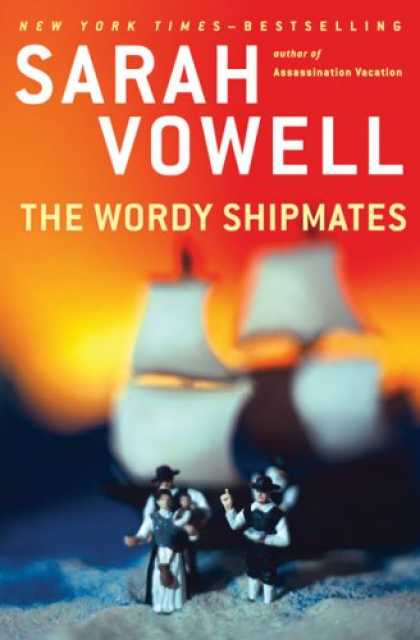
Review: "The Wordy Shipmates," Sarah Vowell


 By Paul Carrier

If you’re looking for a book about the early history of New England that is peppered with references to Elvis Costello, the Brady Bunch, the Boston Red Sox, skateboarding, Ronald Reagan, the Iran-Contra scandal and the 9/11 terrorist attacks, your search is over. The Wordy Shipmates is for you.

Sarah Vowell’s unique perspective on the Puritans of 17th-century Massachusetts offers a soberly offbeat take on these religious zealots., who still loom large in the American character. That's because we have, in Vowell's phrase, inherited their view of themselves as “a beacon of righteousness."

Vowell pulls off the improbable by approaching her topic with serious irreverence, if there is such a thing. She views the Puritans with obvious fondness as a highly principled but deeply flawed group who, at times, may even have been a bit daft.

What Vowell sets out to do, and what she accomplishes in delightfully quirky fashion, is to reclaim the Puritans from our simplistic, negative stereotype of them. Yes, she concedes, they were authoritarian and myopic, but also devout and idealistically committed to the common good of their community as a whole, the common weal.

“I’m always disappointed when I see the word ’Puritan’ tossed around as shorthand for a bunch of generic, boring, stupid, judgmental killjoys,” Vowell writes. “Because to me, they are very specific, fascinating, sometimes brilliant, judgmental killjoys who rarely agreed on anything except that Catholics were going to hell.”

As Vowell makes painfully clear, the excesses of the Puritans were extraordinarily excessive.


Non-conformists like Roger Williams and Anne Hutchinson were banished, and headed south. (For which Rhode Island, which reveres them as founders, is forever grateful.) The Pequot War of the 1630s, in which the English settlers of Massachusetts and Connecticut joined with their Narragansett and Mohegan allies to virtually exterminate the Pequot tribe of Connecticut, is a ghastly preview of Indian wars to come.

Yet Vowell also notes that, in the days after the 2001 terrorist attacks, she was comforted by the words of Massachusetts Bay Colony Gov. John Winthrop, who urged his people to “delight in each other, make other’s conditions our own, rejoice together, mourn together, labor and suffer together” in a true spirit of community. Vowell describes the sentence from which that quote is taken as “one of the most beautiful" in the English language.

The Wordy Shipmates takes its title from Vowell’s claim that the Puritans, far from being the anti-intellectual lemmings of our imagination, were a very argumentative and literary-minded crew who put pen to paper with remarkable frequency. (She shatters another myth by noting that the Puritans were anything but puritanical about sex within marriage. They figured God cooked it up so it must be a good thing.)

In explaining her fondness for these complex, conflicted and sometimes wacky colonists, Vowell draws a distinction between the Pilgrims of Plymouth and the Puritans who settled Boston and the Massachusetts Bay Colony a few years later.


While the Pilgrims were separatists who chose to divorce themselves from the Church of England, the Puritans were “purifiers” who hoped to purge the church of what they viewed as excessive Catholic influences.

Vowell zeroes in on the Puritans who came to Massachusetts Bay from 1628 or so until about 1640, a period that included the settling of Boston, the Pequot War and other notable events. (On a personal note, that migration included two of my ancestors: Matthias Farnsworth, who arrived about 1628, and Rowland Stebbins, who arrived in 1634.)

With that tightly focused time frame and specific setting, The Wordy Shipmates is not a study of the Pilgrims who landed at Plymouth in 1620. Nor does it deal with the most infamous event in 17th-century Puritan history - the Salem witch trials of 1692 and 1693. It is, as Vowell puts it, “about those Puritans who fall between the cracks of 1620 Plymouth and 1692 Salem."

They deserve a closer look, and Vowell provides it, in a style that is all her own.