Thursday, May 7, 2026

Review: "The Savage, Noble Death of Babs Dionne," Run Currie

By Paul Carrier

As Ron Currie’s latest novel opens with a prelude, it’s 1968 and 14-year-old Barbara Levesque is working alone in her uncle’s convenience store in a Franco-American section of Waterville, Maine, known as Little Canada.


In short order, the teenager falls victim to a horrific crime. She reacts in such a way that she has to leave town quickly, and for an extended period of time, only to return five years later.


Fast forward to 2016, when most of the action in the novel takes place. Now widowed, with two drug-addicted adult daughters and a deceased son, Barbara Dionne (Levesque’s married name) is now known to one and all in Little Canada as Babs, a crime boss who controls the prescription drug trade on her turf.


Babs and her small circle of longtime female friends, who effectively help her run Little Canada, are Franco-Americans, descendants of Canada’s 17th-century French settlers. They speak French easily and often, especially when animated or to prevent children from understanding them. They are Catholic, at least technically. Despite their white skin, they have an intimate understanding of bigotry. They have learned, through generations of prejudice, that Anglos, especially the wealthy and the well-connected, look down on them as inconsequential laborers and mill workers.


Babs is domineering, stoic and patient, with a take-no-prisoners outlook. She reigns over her fiefdom. But things are not going well. The French language is fading fast in Little Canada. One of her daughters, Lori, a Marine veteran who served in Afghanistan, routinely sees ghosts. The other daughter, nicknamed Sis, has gone missing. Sis’s husband, Bruce, has a serious drinking problem and a dangerous temper. When Bruce physically assaults his young son, Jason, Babs bashes Bruce with a nightstick and takes the boy home to live with her.


Worse still, at least for Babs, a fixer for a Canadian drug kingpin who is losing business in Maine fingers Babs as the culprit who has been stealing customers and diverting sales. The fixer, referred to in the novel simply as The Man, is a cold-bolded creature, but Babs is nothing if not self-confident. Will this crisis be her undoing?


While Babs grapples with that problem, she also has to cope with a death in her family. That is especially devastating to her because she is feverishly devoted to her shrinking clan. ”If you loved like Babs does, it would break you," one character says. A subsequent death threatens to destroy Waterville, if a raging wildlife  that is barreling down on the city doesn’t do so first.


The Savage, Noble Death of Babs Dionne is a mélange of gruesome violence and uplifting devotion, humor and tragedy, inspiration and revulsion. And, as the title suggests, nobility. Although it is a crime novel, focusing exclusively on genre would not do justice to the novel or its author. Currie, who grew up in a Franco-American family in Waterville, clearly crafted his tale through a loving, even mystical, ethnic lens.


The opening pages feature a quote from Franco-American author Jack Kerouac, whom Currie pointedly refers to by his full (and very French) name: Jean-Louis Lebris de Kérouac. Currie, who has said he was raised in a matriarchal culture, dedicates the novel to his Franco-American and Québécois ancestors. In a genealogical snippet, he lists five generations of his grandmothers by name, adding “and so on, until the very beginning.”


“Je vous aime,” he writes to those who preceded him in the family tree, “et je me souviens de vous.” (I love you, and I remember you.)


Ancestors “are not footnotes to the Very Important Life you’re living now,” Currie tells his readers. “Their ghosts are all around you, clamoring to be seen and heard, like Marley rattling his chains. And like Marley, they have things to teach you.” Think of them all “as yourself,” he advises. “A single entity, spanning centuries.”


When National Public Radio’s Scott Simon asked Currie, in an interview lats year, how he felt about living in the world he created, Currie replied that it was “almost a relief . . . because that world that I grew up in is so completely gone now.” Currie said he is “so thoroughly anglicized and secularized now that it feels like a fantasy or a phantom limb, and it haunts me. And I wanted to be able to make a version of a record of that world before my memories were too fuzzy to do so.”


The Biblio File: images of readers, for bibliophiles


Vilhelm Hammershoi

David Levine on writers: Anthony Lewis

David Levine (1926-2009) was one of America’s most prominent illustrators during a career that spanned decades. No less an authority than Jules Feiffer described him as "the greatest caricaturist of the last half of the 20th century,” although Levine continued to work in the early years of this century as well. Levine’s subjects included himself (above) and people from many walks of life. Authors, scribes and scribblers were a big part of the mix, as these caricatures make clear. 

Lit Toons: Cartoons with a bookish bent

Macanudo

First Lines: Gabriel García Márquez


Many years later, as he faced the firing squad, Colonel Aureliano Buendia was to remember that distant afternoon when his father took him to discover ice.

One Hundred Years of Solitude
Gabriel García Márquez

"They say it's your birthday" - writers born on May 7


Robert Browning  (1812) 
Peter Carey  (1943) 
 Angela Carter  (1940)
Olympe de Gouges (1748) 
David Hume  (1711)
Ruth Prawer Jhabvala  (1927)
Jenny Joseph  (1932) 
Archibald MacLeish  (1892) 
Wladyslaw Reymont  (1867) 
Rabindranath Tagore  (1861) 
Darwin T. Turner  (1931)
Gene Wolfe  (1931)
 

Wednesday, May 6, 2026

Review: "Missing," E.A. Jackson

By Liz Soares

It’s a hot summer in London in 1990 when Baby Bella goes missing. Detective Inspector Martha Allen has misgivings about taking the case. She’s never handled anything like it. Allen could reveal she’s pregnant as an excuse; then again, she’s ambitious. So she strides headfirst into a case that will ultimately haunt her for nearly 30 years.


Thomas and Vivien Carpenter have come to the city for a getaway from their home in Wells, in the southwest of England. They’re staying at the Bellevue Hotel in Pimlico. Their daughter, Bella, slumbered in a Moses basket by an open window, while her parents slept in bed. Thomas awoke in the early hours of the day to find the baby gone.


Officers are called in from across the city; this is a big case. Allen enlists the help of Detective Constable Manley Desbury. She doesn’t know him, but they develop a solid working relationship.


Promising leads are followed but turn out to be dead ends. A scrap of fabric, a smear of blood are all the detectives have as clues. No one has seen anything. Allen is desperate. She wants to find the baby, of course, but she also envisions her career going down the tubes if the case is not solved.


Then, a beautiful young woman shows up with Baby Bella. Nell Beatty says she found the tot on a park bench. Allen starts to question her, but she disappears. She’d given the police false information, and they are unable to find her again.


Allen wants to keep the case open; she doesn’t think the whole story has been told. But when even Desbury lets her know he thinks she’s pushing too hard, she backs off.


Then, in 2020, just before the pandemic causes shutdowns and a massive disruption to everyday life, DI Desbury calls Allen, now in admin at Scotland Yard. A body has been found on his turf in Bristol. It’s Nell Beatty.


Allen can’t help herself. The wound of what to her was an unfinished case is reopened. She has to find out what really happened to Baby Bella.


Desbury is willing to help her, to a degree. He also needs to find Nell Beatty’s murderer. The trail is thin, and Allen has to remind herself “this is why they call us the plod.” Eventually, Allen does learn enough to close the case in her own mind, and to move on with her life.


For the reader, though, there’s one final twist.


This was a deeply satisfying, page-turning read, as much about the cost of not solving a crime as it is about solving it.


I knew from the first page I was going to enjoy it. Allen is a likable, relatable character and her tenacity is admirable. The suspense is intense; kernels of of the truth emerge, but it is truly not until the final page that all is revealed.

I enjoy police procedurals in general, but Missing is something more. The detective work is there, but this is also Allen’s story. And, of course, Baby Bella’s.


The Biblio File: images of publishers, for bibliophiles

Atlantic Books

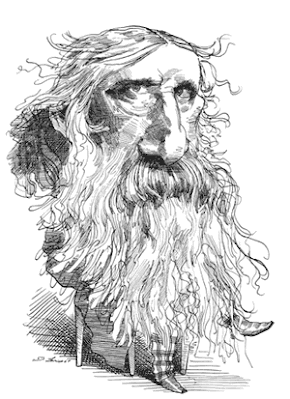
David Levine on writers: George MacDonald

David Levine (1926-2009) was one of America’s most prominent illustrators during a career that spanned decades. No less an authority than Jules Feiffer described him as "the greatest caricaturist of the last half of the 20th century,” although Levine continued to work in the early years of this century as well. Levine’s subjects included himself (above) and people from many walks of life. Authors, scribes and scribblers were a big part of the mix, as these caricatures make clear. 

Lit Toons: Cartoons with a bookish bent


First Lines: T.C. Boyle


She was running late, always running late, a failing of hers, she knew it, but then she couldn't find her purse and once she did manage to locate it (underneath her blue corduroy jacket on the coat tree in the front hall), she couldn't find her keys.

Talk Talk 
T.C. Boyle

"They say it's your birthday" - writers born on May 6


Jeffrey Deaver  (1950)
Ariel Dorfman  (1942)
Randall Jarrell  (1914)
Gaston Leroux  (1868) 
Harry Martinson  (1904) 
 

Tuesday, May 5, 2026

The Biblio File: images of N.E. libraries, for bibliophiles

Little Free Library, Hingham, Massachusetts

David Levine on writers: Robert Bly

David Levine (1926-2009) was one of America’s most prominent illustrators during a career that spanned decades. No less an authority than Jules Feiffer described him as "the greatest caricaturist of the last half of the 20th century,” although Levine continued to work in the early years of this century as well. Levine’s subjects included himself (above) and people from many walks of life. Authors, scribes and scribblers were a big part of the mix, as these caricatures make clear. 

Lit Toons: Cartoons with a bookish bent

The Brilliant Mind of Edison Lee

First Lines: Tom Robbins


The magician's underwear has just been found in a cardboard suitcase floating in a stagnant pond on the outskirts of Miami.

Another Roadside Attraction
Tom Robbins

"They say it's your birthday" - writers born on May 5


Nellie Bly  (1864)
Kaye Gibbons (1960)
Hank Green  (1980)
Soren Kierkegaard  (1813)
Leo Lionni  (1910)
Karl Marx  (1818)
Christopher Morley (1890)
 

Monday, May 4, 2026

The Biblio File: images of cover art, for bibliophiles

David Levine on writers: Sam Shepard

David Levine (1926-2009) was one of America’s most prominent illustrators during a career that spanned decades. No less an authority than Jules Feiffer described him as "the greatest caricaturist of the last half of the 20th century,” although Levine continued to work in the early years of this century as well. Levine’s subjects included himself (above) and people from many walks of life. Authors, scribes and scribblers were a big part of the mix, as these caricatures make clear.  

Lit Toons: Cartoons with a bookish bent

Tom Gauld